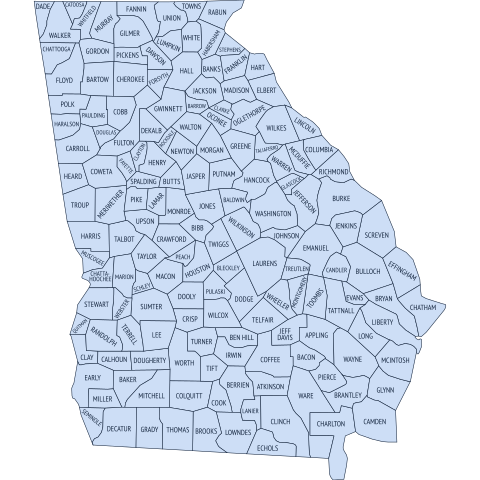
Floyd County, Georgia Court Records
Floyd County court records are official documents created and maintained by the courts in the course of handling a legal case. These records include case filings, court orders, judgments, hearing dates, and other documents produced throughout the court process. According to O.C.G.A. § 15-6-61, the official custodian of Floyd County court documents is the clerk of the county's superior court.
Court records do not exist in isolation. Court records are directly connected to other public records. A police arrest usually results in an arrest record, which can then be connected to a filed court case. Vital records may also be connected to court cases that involve births, deaths, name changes, and marriages.
Are Floyd County Court Records Public?
Yes. Floyd County court records are public records. Anyone has the right to see and acquire copies of public records held by government agencies, including court records kept by the county Superior Court Clerk (O.C.G.A. § 50-18-70).
But not all court documents are accessible to the general public. In some situations, restricted records are only accessible by authorized individuals, such as parties directly involved in the case or attorneys of record:
- Juvenile court records (O.C.G.A. § 15-11-701)
- Adoption records
- Details about victims of sexual offenses
- Sealed records
What Information is Available in Floyd County Court Records?
Floyd County court records contain a range of information on all legal proceedings handled in the county. Persons searching these records may find the following:
- Each party's full name
- The court-assigned case number
- Filing date of the complaint or charge
- Type of case (civil, criminal, domestic, or probate)
- The designated judge's name
- Docket entries showing each court action and hearing date
- Final court ruling, order, or sentence
- Names of all the attorneys involved in the case
- Court rulings on motions or requests
- Criminal charges filed
Floyd County Court Records Search
A Floyd County court records search can be done online, in person, by mail, or by phone. It is important to send the request to the appropriate court.
Online Access
- The Floyd County Superior Court, through its case search system, offers online access to civil and criminal case information. On the court's website, click "case search" in the top-right corner to access the case search system. Searches may be completed using a case number, party name, or date.
- Older records might not be accessible online. Court files and documents filed after 2013 require direct contact with the Superior Court Clerk.
- The Probate Records system can be used to search guardianships, wills, estate records, and probate matters. Most records from 2006 onward are available online.
- The Magistrate Court online records portal allows users to access information on minor claims, evictions, ordinance infractions, and specific warrant proceedings. On the court website, click "Public Records search" to access the portal.
In-Person Access
- To view public court records in person, interested parties can go to the Floyd County Government Plaza. The Government Plaza houses the clerks of the Superior Court, Probate Court, and Magistrate Court.
- Record searches can be done for free at public access computer terminals.
- If court employees help retrieve records or print copies, there may be fees.
- Public access to sealed records, juvenile cases, adoptions, and other private information is restricted.
Mail and Phone Requests
- Requests by phone and mail typically take 5 to 14 business days.
- Names, case numbers, document descriptions, contact details, and a self-addressed, stamped envelope should all be included in the submitted request.
- Cashier's checks and money orders are accepted forms of payment. Cash and personal checks are not accepted.
- Before mailing a request, interested parties can confirm fees, page counts, and processing requirements by calling the relevant court.
- The phone numbers and mailing addresses for each court are listed below:
Floyd County Superior Court
Mailing Address:
P O Box 1110
Rome, GA 30162
Phone: (706) 291-5190
Probate Court of Floyd County
3 Government Plaza
Suite 201
Rome, GA 30161
Phone: (706) 291-5136
Floyd County Magistrate Court
3, Government Plaza
Suite 227
Rome, GA 30161
Phone: (706)291-5250
Fees for Court Records in Floyd County
Floyd County court documents are available for free viewing. However, printing, copying, and staff time spent locating and managing documents are all subject to fees. State law establishes the following fees under O.C.G.A. § 15-6-77 (Superior Court) and O.C.G.A. § 15-10-80 (Magistrate Court):
- Superior Court self-service uncertified copies cost $0.50 per page, while clerk-assisted copies cost $1.00 per page.
- The first page of a certified Superior Court copy costs $2.50, and each extra page costs $0.50.
- Certified copies from the Magistrate Court: $2.50 flat cost
- Standard copies for Magistrate Court: $1.00 per page
- Staff search time is free for the first fifteen minutes, after which it is charged at the hourly rate of the lowest-paid qualified employee.
- Faxing or electronically transmitting court documents costs $2.50 for the first page and $1.00 for each additional page.
Floyd County Courthouse Locations
The Floyd County court network consists of a Superior Court, a Juvenile Court, a Probate Court, a Magistrate Court, and two Municipal Courts. Only the Municipal Court of Cave Springs is not located in the County Plaza. Below are all the courthouse addresses and contact information:
3 Government Plaza, Suite 101
Rome, GA 30161
Phone: (706) 291-5190
3 Government Plaza, Suite 202
Rome, GA 30161
Phone: (706) 291-5180
3 Government Plaza,
Rome, GA 30161
Phone: (706) 291-5136
3 Government Plaza, Suite 227
Rome, GA 30161
Phone: (706) 291-5250
Municipal Court of Cave Spring
10 Georgia Avenue
PO Box 365
Cave Spring, GA 30124
Phone: (706) 777-3382
Municipal Court of Rome
5 Government Plaza
Rome, GA 30161
Phone: (706) 238-5150
Criminal Records Access in Floyd County
Official state criminal background checks are not handled by Floyd County courts. The Georgia Bureau of Investigation (GBI), which maintains all of the state's criminal records, is the place to go for a complete criminal history report. These requests are handled by the GBI rather than the county courts.
Local criminal case records filed in Floyd County are handled by the county's Superior Court. Magistrate Court holds records for misdemeanors. Interested persons can access these records through two options:
- Online search: Interested persons may search the county's criminal case records through the Floyd County Superior Court's online case search system. On the court'swebsite, click "case search" in the top-right corner to access the search system. For misdemeanor-related records, visit the Magistrate Court online records portal. On thecourt website, click "Public Records search" to access the portal.
- In-person search: Or, parties can go to the Superior Court Clerk's office. Staff can help find case files during regular business hours. To see misdemeanor records, visit the Magistrate Court Clerk's office during work hours.
Floyd County Probate Records
Floyd County probate records refer to the official documents created and kept by the Floyd County Probate Court. These documents deal with guardianships, conservatorships, estate administration, and other county-wide civil cases. The Probate Court section of the county website has a "GA Probate Records" tab that provides public access to the county's probate records. Filings since 2006 are available. Additionally, records searches in person at the Probate Court is another lookup option.
Common examples of probate records include:
- Wills: Legal documents directing how a deceased person's estate is distributed
- Trusts: Arrangements where one party manages assets for the benefit of another
- Guardianships: Court proceedings that assign legal custody of a minor or incapacitated adult to a designated guardian
- Conservatorships: Court-supervised arrangements that place financial management of a person's estate under a court-appointed conservator
(Note:) O.C.G.A. Section 29-9-18(a) and O.C.G.A. § 37-3-166(a) prohibit public access to guardianship, conservatorship, and mental health records.
Floyd County Family Court Records
The Floyd County Superior Court is in charge of family court records in the county. The type of case determines access to these records:
- Divorce: The final divorce documents are available to the public. However, O.C.G.A. § 9-11-7.1 prohibits the removal of personally identifiable information from public copies.
- Child Custody: The public can view case dockets. According to O.C.G.A. Section 49-5-40, records pertaining to abuse and neglect investigations are sealed.
- Adoption: Every adoption record is completely sealed. According to O.C.G.A. Section 19-8-23, access to them requires a court order.
- Child Support: The public has access to final decisions. The Division of Child Support Services maintains confidential records.
- Paternity: The public can view case dockets. O.C.G.A. Article 31-10-25 restricts paternity acknowledgments and birth records.
The Superior Court's case management system allows interested parties to look up family court data online. To acquire certified copies from the office of the Court Clerk:
- Send a request to the office of the clerk.
- Describe the case in detail.
- Pay the necessary certification and copy fees.
- If requesting restricted records, show a valid government ID.
Federal Court Records in Floyd County
Federal court records are documents generated by United States District Courts. These include records from cases involving federal laws, disputes between parties from different states, and matters where the federal government is a party. Interested persons seeking federal court records in Floyd County may access these through the Public Access to Court Electronic Records (PACER) system. PACER is an online platform that provides access to case and docket information from federal courts across the country. Registration is required, and costs $0.10 per page viewed. Documents not available online may be requested directly from the federal court clerk's office.